

What is NeuroScent™?
NeuroScent™ is a neuroscience-based research method that reveals how the brain responds to different scents. It goes beyond asking which scent consumers consciously prefer by showing which emotions, associations and motivational responses each scent activates.
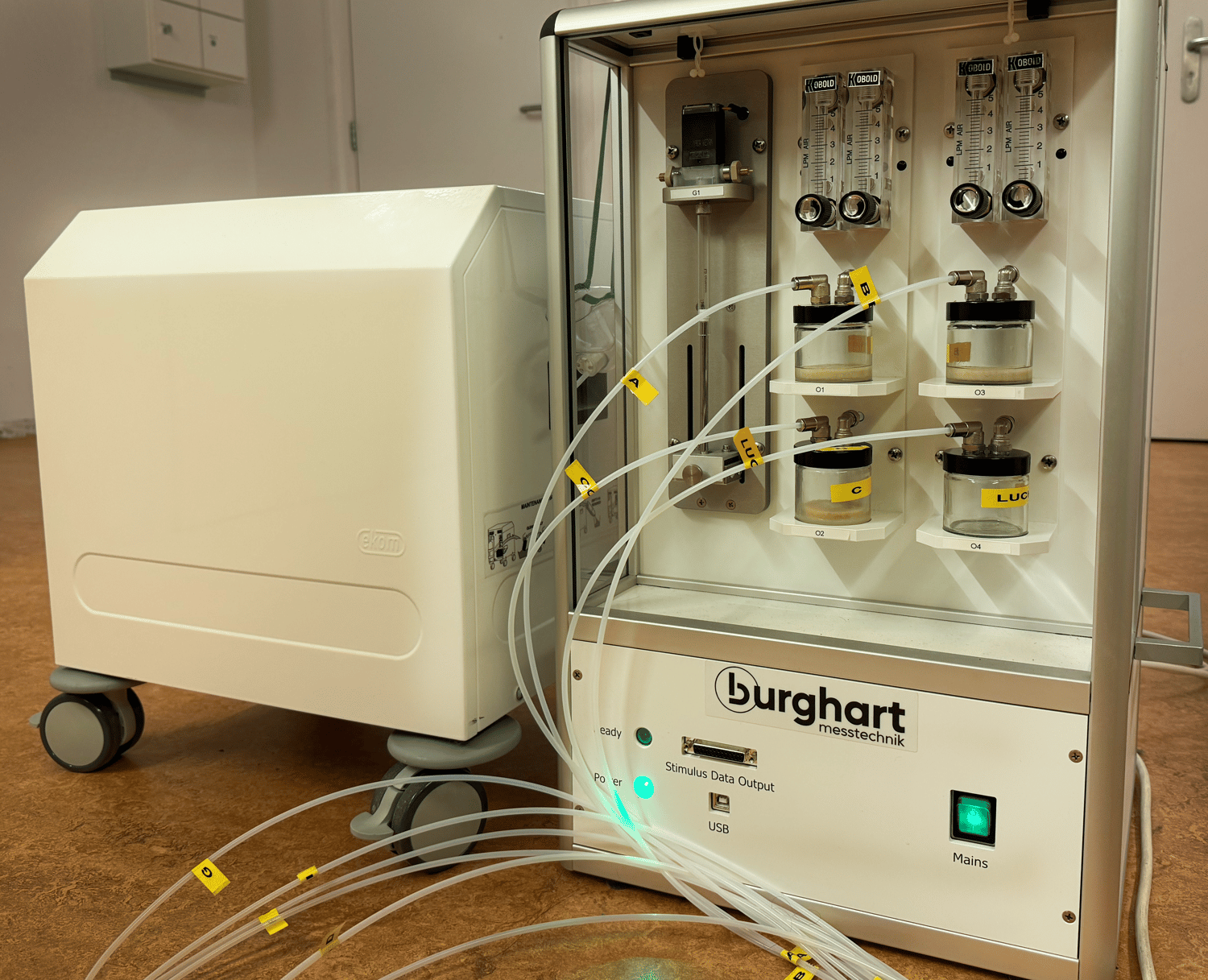
During the study, an olfactometer delivers each scent in precisely controlled doses while the participant undergoes an fMRI scan. This allows us to measure the brain’s response to each scent individually and compare different scents directly.
The result is a neural response profile for each scent. Two scents may receive similarly positive conscious ratings, yet trigger very different responses in the brain. One scent may strengthen trust or recognition, while another may generate greater appeal, reward or even avoidance.
NeuroScent™ makes these differences visible and helps predict which scent is most likely to create the desired brand, product or environmental experience.

Why is scent such a powerful influence on consumer behaviour?
Consumers can usually tell you whether they like a scent. What is much harder is explaining what that scent does to them and why they respond to it. Scent processing is closely linked to brain systems involved in emotion, memory and association. As a result, a scent can evoke feelings of freshness, luxury, comfort or familiarity without people being consciously aware of its influence. These responses can shape how they experience a product, brand or environment.
Scent can influence:
- Brand and product evaluation: how positively consumers experience a brand, product or environment.
- Time spent and time perception: how pleasant a space feels and how long people want to stay.
- Purchase intention and behaviour: whether a product feels more appealing, relevant or appropriate.
- Memory: how strongly a brand, product or experience is remembered.
- Emotional associations: such as freshness, luxury, comfort, trust or a sense of security.
The impact of scent depends heavily on context. A scent that works well for a premium product may not be right for a more accessible brand or a different environment. Similarly, a scent may be pleasant in isolation but add little to the product, packaging or brand promise.
A pleasant scent is therefore not necessarily the most effective one. NeuroScent™ reveals which scents activate the desired emotions and associations, and helps predict which option is most likely to strengthen the intended brand or product experience.
Where NeuroScent™ adds value

NeuroScent™ is particularly valuable when scent plays an important role in how people experience a product, brand or environment. For example, when developing a new scent, comparing several scent options or predicting which scent is most likely to create the desired response before launch.
NeuroScent™ can be used for:
- A signature scent for a physical environment, such as a shop, hotel or showroom.
- Product scents, for example in food, beauty, personal care or home care.
- Scented packaging, where scent forms part of the consumer’s first product experience.
- A new sensory brand identity, where scent works alongside visual design, sound, materials or the surrounding environment.
- A product launch, where you want to understand in advance which scent is most likely to create the intended experience.
NeuroScent™ can also form part of broader multisensory research. In these studies, we look not only at scent in isolation, but at how it interacts with other sensory cues as part of the overall brand experience.
This helps predict which scent will make the strongest contribution to the intended brand or product experience in the context in which it will actually be used.
How does a NeuroScent™ study work?
A NeuroScent™ study combines precisely controlled scent delivery with neuroscientific measurement and a brief conscious evaluation afterwards. The aim is to identify which scent evokes the desired emotional response in the brain.
A typical NeuroScent™ study consists of the following steps:
-

Define the research question
First, we determine which decision the research needs to support. This might be identifying the scent that best fits the brand, finding the variant that evokes the desired emotion, or understanding how scent interacts with packaging, a product or visual communication. Moreover, we define which scents and research conditions will be compared.
-

Delivering the scents under controlled conditions
Participants smell different scents while their brain activity is measured using fMRI. A specially designed scent-delivery system, the olfactometer, ensures that each scent is presented at precisely the right moment and under controlled conditions.
This allows us to compare the brain’s response to each scent reliably.
-

Mapping the neural response to scent
While participants smell each scent, we measure the patterns of brain activity it evokes. We look at processes associated with factors such as attraction, reward, trust, valuation, recognition and aversion. This reveals how the neural processing of different scents differs.
-

Measure the conscious experience
After the study, participants complete a questionnaire. They may be asked how pleasant, recognisable, intense or appropriate they found each scent, and which variant they prefer.
-

Reporting & recommendations
You receive a clear NeuroScent™ report with interpretation and practical recommendations based on our neuroscience expertise. We are also happy to present the findings and discuss what they mean for your brand or product.
Who can benefit from NeuroScent™?
NeuroScent™ is relevant for organisations where scent and the overall sensory experience play an important role in the product experience, brand promise or customer environment.
The method is particularly valuable for:
- Retail and hospitality brands
Looking to use scent in shops, hotels, showrooms or other physical customer environments. - FMCG and product brands
Comparing scent concepts for products, packaging or new variants. - Beauty, personal care and fragrance brands
Where scent is a central part of the product experience and positioning. - Food and beverage brands
Exploring how scent interacts with taste, packaging and expectations. - Automotive, interior and luxury brands
Developing a distinctive and relevant sensory brand identity. - Marketing, innovation and product teams
Looking to make scent decisions based on more than conscious preferences or internal opinion.
NeuroScent™ is suitable for both established brands and challengers that want to identify in advance which scent has the greatest potential to strengthen their brand or product experience.
How NeuroScent™ helps your brand make better scent decisions
With NeuroScent™, we identify which scent is not only rated positively at a conscious level, but also evokes the brain responses that support the intended effect. This helps predict which scent is most likely to strengthen the brand or product experience.
The findings support decisions in scent development, product development and sensory marketing. This reduces the risk of choosing a scent based mainly on internal preference when another variant is likely to have a stronger impact on consumers.
NeuroScent™ can reveal:
- which scent is most likely to strengthen the intended brand or product experience;
- which scent activates attraction, valuation, recognition or trust;
- how different scents differ at a neural level;
- which scents may trigger negative responses or avoidance;
- whether a scent fits the product, packaging and brand promise;
- how scent interacts with visual design and other sensory cues.
This helps brands invest more confidently in scent concepts that are most likely to strengthen brand experience, product appeal and differentiation.
The Neurensics approach to scent research
Scent is a sensory cue that often works outside conscious awareness. That is precisely why effective scent research requires more than a questionnaire or focus group. Neurensics combines neuroscience expertise, advanced measurement methods and extensive experience in consumer research to study scent responses where they originate: in the brain.
With NeuroScent™, we combine controlled scent delivery through an olfactometer with fMRI. This allows us to see not only which scent people consciously find pleasant, but also which scent evokes the desired emotional and motivational responses in the brain. Based on these responses, we can predict which scent is most likely to have the strongest impact on the brand or product experience.
What sets Neurensics apart is our ability to translate complex neural data into practical business decisions. We do not simply deliver brain data; we provide clear insights that help brands make better choices in product development, retail experience, packaging and sensory brand strategy.
In this way, NeuroScent™ goes beyond traditional scent research: it reveals what a scent evokes beneath the surface and helps identify which option best supports the intended effect.
Discover what NeuroScent™ could do for your brand
Want to know which scent is most likely to have the strongest impact on your brand or product? With NeuroScent™, we measure not only which scents people consciously prefer, but also which ones evoke the desired unconscious responses in the brain.
This allows you to base scent decisions on measurable brain responses and invest more confidently in the scent with the greatest potential to strengthen your brand experience, product experience or sensory identity. Contact us to discover how NeuroScent™ can help you use scent more strategically and support your decisions with neuroscience.
Frequently asked questions
How does NeuroScent™ differ from traditional scent research?
Traditional scent research often asks consumers which scents they find pleasant, appropriate or recognisable. NeuroScent™ goes beyond this conscious evaluation. We measure the responses that different scents evoke in the brain, revealing which scent is not only pleasant, but also best supports the intended brand experience.
Which research methods are used in NeuroScent™?
In a NeuroScent™ study, scents are delivered under precisely controlled conditions using an olfactometer. While participants smell each scent, we use fMRI to measure the responses it evokes in the brain. Afterwards, participants complete a short questionnaire about their conscious experience of the scent and the reasons behind it.
When can NeuroScent™ add value to my brand?
NeuroScent™ is valuable when scent plays an important role in the product experience, customer experience or brand perception. This could include product scents, scents used in shops or hotels, scented packaging or scent concepts for a new launch. The research helps identify which scent best supports the intended brand or product experience.
Can NeuroScent™ be combined with research into other senses?
Yes. NeuroScent™ can form part of broader multisensory research. Rather than studying scent in isolation, we can examine how it interacts with visual design, sound, packaging, materials or the surrounding environment. This provides a more complete understanding of the overall brand experience.
How long does a NeuroScent™ study take?
The timeline varies by project and depends on the research question, the number of scents being tested and the level of reporting required. Before the study begins, we agree on the most suitable research design and timeline based on your needs.
Is NeuroScent™ suitable for smaller product launches?
That depends on the role scent plays in the launch. If scent is important to the first impression, product experience or brand associations, NeuroScent™ can provide valuable insight. During an initial consultation, we can determine whether the method is appropriate for your research question, timing and investment.
Get in contact
Martin de Munnik
Co-founder & Business Developer
Want to learn more about NeuroScent™?
Andries van der Leij
Head of Research & Development
Want to learn more about our research methods?
Start a project
Have questions about what NeuroScent™ could do for your business? Get in touch with Martin to discuss the possibilities.
Martin de Munnik
Have questions about the research methods used by Neurensics? Get in touch with Andries to learn more.