
Would you like to learn more about the neuroscientific study? Simply give us a call at our general number: 06 14 48 51 96 or send an email to contact@neurensics.com.
10x Stronger Emotional Reaction at the Museum
Viewing an original painting at the Mauritshuis triggers an emotional response in the brain that is 10 times more intense than viewing a reproduction. The standout piece in the study? Vermeer’s Girl with a Pearl Earring. Why? Here are the key reasons:
The Girl pulls you into a Sustained Attentional Loop
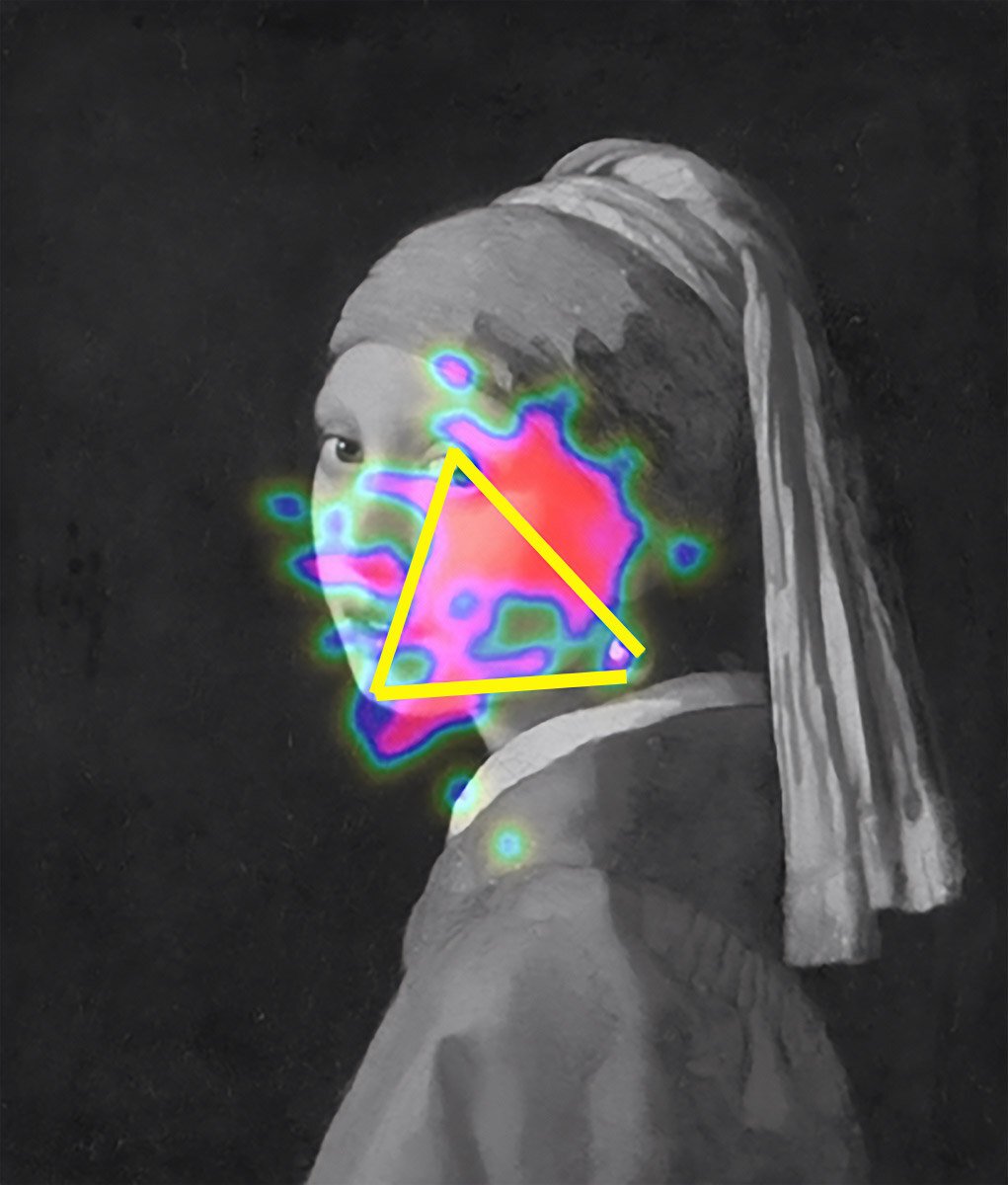
No other painting in the study captivates your gaze like Girl with a Pearl Earring. It doesn’t just attract you—it holds your attention in a continuous loop. Your gaze moves from her eyes to her mouth, then to the pearl, and back again. Eyes, mouth, pearl. Over and over. You simply can’t look away.
The Girl activates the precuneus like no other artwork
Looking at Girl with a Pearl Earring sparks greater brain activity than any other analyzed work—especially in the precuneus. This part of the brain is vital for consciousness, self-reflection, and processing personal life experiences.

How Does Art Affect Our Brain?
What happens in our brain when we look at art? To find out, we conducted an EEG measurement—a sort of “brain movie.” Participants wore electrodes on their heads to record brain activity while viewing paintings at the Mauritshuis as well as reproductions of these works.
Using eye-tracking, we observed where their gaze traveled. Later, the participants viewed the same reproductions in an MRI scanner at the University of Amsterdam.
The result? Art is good for the brain. Independent neuroscientist Erik Scherder explains what happens in our minds when we look at art—and why it’s so valuable.
What Is the Secret Behind the “Girl with a Pearl Earring”?
Why is it impossible to look away from her? Humans are naturally drawn to faces. When we see someone—whether in real life, a photo or a painting—our brain instinctively tries to decode the emotions of that person to determine whether they are “safe.”
Johannes Vermeer cleverly takes advantage of this natural behavior and achieves something extraordinary. He creates what is known as a sustained attentional loop. His “Girl with a Pearl Earring” doesn’t just capture your gaze—it holds your attention in a continuous loop.
Typically, we instinctively focus on the eyes and mouth first, as they provide the most information about emotions. But with the “Girl with a Pearl Earring,” something remarkable happens: You start by looking at her eyes and mouth, then immediately shift to the pearl. Afterward, your gaze returns to her eyes and mouth, only to be drawn back to the pearl once again. And this doesn’t happen just once or twice—it happens repeatedly.
Why This Study?
Do you have a “Girl with a Pearl Earring” at home? If so, you’re not alone—it’s everywhere. This led us to wonder: what exactly is the added value of seeing the original painting in person when reproductions are so widely available?
The Value of This Study
Art historian and technical expert Liselore Tissen, who is pursuing her PhD on the significance of replicas in the field of art history, participated in this study as an independent researcher. This research places the visitor at the center, revealing that the art experience is not just about the artwork itself but also about elements like the space, lighting, and frame. It underscores the importance of visiting a museum for a truly immersive art experience.